
Antminer S21 & T21 Hashboard Specialists
Chip-level repair for the Antminer S21 and T21 (SHA-256). We restore boards built on 108 BM1368 chips — clearing dead voltage domains, power-circuit faults and short chip counts to bring your hashrate back to spec.
Full Overhaul
Deep cleaning, thermal paste refresh and aging-component checks tuned for the S21/T21's high-density 5nm layout.
Dead Domain Fix
Locating the shorted chip that took a whole 9-chip voltage domain offline, and restoring the ~1.2V rail.
Board Stability
Resolving short chip counts, low hashrate, fan/temperature-sensor errors and communication dropouts.
Chip Replacement
Precision replacement of BM1368 ASIC chips with genuine Bitmain parts using professional reflow stations.
Proven Track Record on eBay/Contract
100% Honest Feedback from Verified ASIC Owners
"Great guy, answered all my questions... Good fast work, best prices."
"Best service out there. Doesn't overcharge for repairs unlike other services. Definitely will be using again."
"Awesome service had it fixed and shipped back in a matter of days... highly recommend them."
S21 reporting 99 of 108 chips after a grid surge
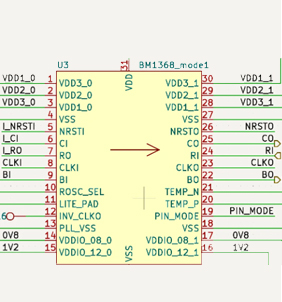
A representative Antminer S21 hashboard repair. Board architecture: 108× BM1368 5nm chips in 12 voltage domains (9 chips per domain, ~1.2 V per domain). The S21 has no PIC — the control board manages the core-voltage setpoint over I2C.
- Reported symptom
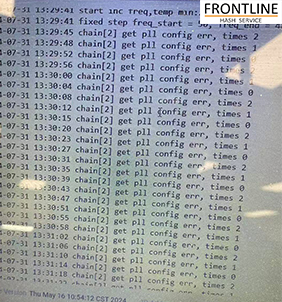
- One board underperforming after an unstable-power event. The log read
chain[1] find 99 chipsinstead of 108 — a 9-chip shortfall. - On-bench diagnosis
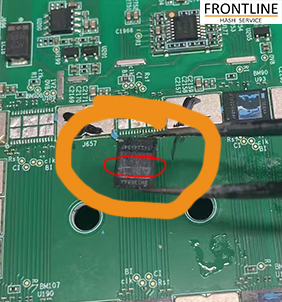
- A missing block of exactly 9 chips maps to one dead voltage domain (9 chips × 12 domains). We measured each domain rail; one sat out of range instead of ~1.2 V. A short-to-ground check and thermal imaging pinpointed one BM1368 that had shorted and pulled its entire domain down.
- Root cause
- A power surge on unprotected input stressed the board and shorted a single BM1368. Because the nine chips in a domain are series-wired, one failure silences the whole group — the classic S21/T21 "short chip count" symptom.
- The repair
- We cleared the short, replaced the failed BM1368 with a genuine Bitmain chip using a controlled hot-air profile (~350–380°C) and 0.4 mm reball, then verified the domain returned to ~1.2 V and all 12 domains reported over I2C. We also checked the input connectors for surge/heat damage.
- Outcome
- Full 108-chip count restored and rated hashrate recovered. The board passed a 24-hour full-load burn-in before return. The same domain-failure logic applies to the T21, which shares the BM1368 architecture.
Representative case based on common S21/T21 failure patterns and standard chip-level repair procedure. Every board is diagnosed individually — exact faults and pricing are confirmed after inspection.
Antminer S21 & T21 Repair — What We Fix
The Antminer S21 and T21 are Bitmain's current-generation SHA-256 (Bitcoin) miners, built on 108 BM1368 5nm ASIC chips arranged in 12 voltage domains of 9 chips each. That 5nm process is efficient but unforgiving: tighter tolerances mean the S21/T21 is far more sensitive to power-delivery quality than the S19 generation, and a marginal PSU or a surge that an S19 shrugged off can drop an S21 domain instantly.
The failures we see most are short chip counts (a dead voltage domain caused by one shorted BM1368), low or unstable hashrate, fan and temperature-sensor errors, and communication dropouts between the hashboard and control board. We diagnose each board on a test fixture, isolate the fault with domain-voltage and short-to-ground checks plus thermal imaging, replace failed chips with genuine Bitmain parts, and run a 24-hour full-load burn-in before return. Mail-in and on-site farm service are both available.
S21 / T21 Repair — Frequently Asked Questions
How much does S21 / T21 repair cost?
It depends on the fault — clearing a single dead domain is far cheaper than replacing multiple BM1368 chips. We diagnose the board first and send a transparent, itemized quote before any work. Chip-level repair is almost always a fraction of a new hashboard.
What common S21 / T21 faults do you repair?
Short chip counts like "chain[X] find Y chips", dead voltage domains (a missing block of ~9 chips), low or unstable hashrate, fan and temperature-sensor errors, communication faults, and power-delivery failures.
What chip does the S21 and T21 use?
Both use 108 Bitmain BM1368 5nm SHA-256 chips in 12 voltage domains of 9 chips each, at roughly 1.2V per domain. For the S21 Pro, S21 XP and S21+, which use BM1370 chips, see our S21 Pro / S21 XP repair page.
What is the turnaround time?
Most mail-in S21 / T21 boards are repaired within a few business days of arrival, followed by a 24-hour full-load burn-in before return. On-site farm repairs are scheduled with our technicians.
Do you offer on-site S21 / T21 repair for farms?
Yes — we provide on-site ASIC repair so mining farms can restore dead S21 and T21 units on their own floor without shipping downtime.
Related ASIC Repair Services
Need your S21 or T21 Repaired?
Professional mail-in and on-site repair for the Antminer S21 and T21 — fast turnaround guaranteed.