
Antminer Z15K Hashboard Repair
The Z15K is Bitmain's mid-range Equihash machine — 525 kSol/s at 2,483 W, built on the same 12 nm Z15-family architecture as the Z15 and Z15 Pro. It is a new configuration rather than a new generation, so the faults we repair on it are the ones this family is known for: power-path faults, low hashrate, chains that drop out, and temperature-sensor errors.
Power-Path Faults
Short-circuit and core-voltage diagnosis on the input stage, MOSFETs, inductors and sense resistors — the cause of most "dead" Z15K boards.
Low Hashrate & Missing Chips
Locating dropped-out ASICs and unstable voltage domains that hold a Z15K below its rated 525 kSol/s.
Board Not Detected
Repairing broken serial TX/RX chains, dead rails and connector or sense-harness faults behind "cannot find hashboard".
Temperature & Cooling
Thermal-interface refresh, heatsink cleaning, and repair or replacement of the on-board temperature-sensor circuit.
Proven Track Record
Unedited feedback from verified ASIC owners
Top-rated across public marketplaces
"Great guy, answered all my questions... Good fast work, best prices."
"Best service out there. Doesn't overcharge for repairs unlike other services. Definitely will be using again."
"Awesome service had it fixed and shipped back in a matter of days... highly recommend them."
Z15K mining under rating, then one chain vanished
A representative Antminer Z15K repair: the unit never reached its rated 525 kSol/s, then a chain stopped being detected entirely.
- Reported symptom
- The unit ran around 70% of rated hashrate, hardware errors climbed slowly, then one chain dropped offline with
cannot find hashboard. - On-bench diagnosis
- One voltage domain sagged under load while the others held, a sense resistor had drifted out of tolerance, and the serial chain broke mid-board — clock reached a chip but data never came back. Thermal paste was dried out and the heatsink fins were packed with dust.
- Root cause
- Sustained over-temperature dried the thermal interface and thermally fatigued a solder joint in the chain. The drifted sense resistor made the board report a voltage it did not have, so firmware throttled what was still alive instead of flagging the real fault.
- The repair
- We replaced the drifted sense resistor, reflowed and then replaced the fatigued ASIC with a genuine part, restored the sagging core-voltage rail under a current-limited supply, and refreshed the full thermal interface (paste plus deep heatsink clean).
- Outcome
- Every chain detected again, hashrate back at the published rating, rail voltage stable under load, and a clean 24-hour full-load burn-in before the unit shipped back.
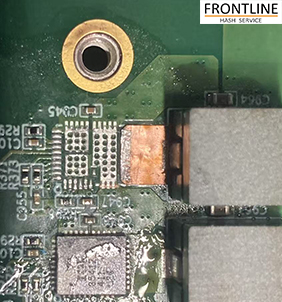
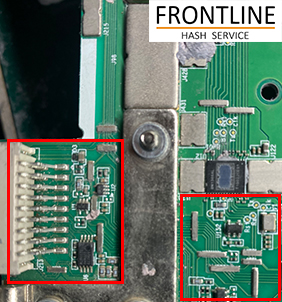
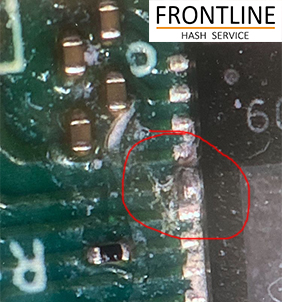
Bench photos from the Z15-family boards we service. Every Z15K is diagnosed individually — exact faults and pricing are confirmed after inspection.
Antminer Z15K Repair — What We Fix
The Antminer Z15K is Bitmain's mid-range Zcash (Equihash) unit: 525 kSol/s at 2,483 W, roughly 4.73 J/kSol, on a 200–240 V single-phase feed. Bitmain announced it in August 2026 and it uses the same 12 nm Z15-family architecture as the Z15 and Z15 Pro — a new configuration of proven hardware, not a new generation. That is good news for repair: the failure modes are the ones this family is known for, and they are repairable at component level.
Because the Z15K squeezes more hashrate than the original Z15 into a shoebox-sized chassis with only two fans, thermal headroom (not raw wattage) is what limits it — it is rated at 4.73 J/kSol against the Z15 Pro's ~3.15 J/kSol. A clogged heatsink or a weak feed pushes chip temperatures up, which dries the thermal interface, fatigues solder joints in the serial chain, and drifts the sense resistors the control board relies on. The result is a unit that quietly mines below its rated 525 kSol/s, throws hardware errors, then loses a chain — the exact chain of events in the bench log above.
We work the Z15K in a fixed order: power path first, chain second, sense circuit third, ASIC last. On these boards six ASICs sit across three power domains, so one dead chip costs a large share of that board's output and a sagging domain shows up as a missing chip long before it shows up as a dead board. That means short-circuit and core-voltage diagnosis on the input stage and MOSFETs, reflow or replacement of individual ASICs with genuine parts, repair of broken TX/RX links and connectors, replacement of drifted sense components and temperature sensors, and a full thermal-interface refresh. Every board then runs a 24-hour full-load burn-in before it goes back into a rack. Mail-in and on-site farm service are both available. Running the older or bigger sibling? See our Antminer Z15 / Z15J repair page or the Z15 Pro repair page.
Z15K Repair — Frequently Asked Questions
What are the Antminer Z15K published specs?
Vendor listings state 525 kSol/s at 2,483 W — about 4.73 J/kSol — on 200–240 V single-phase power, with two fans, roughly 5.9 kg and a 245 × 132 × 290 mm chassis. It runs Equihash and targets Zcash (ZEC), with Komodo, Hush and Pirate Chain as the other options. Bitmain announced it on 21 August 2026 and the first batch shipped from 31 August 2026.
What faults do Z15K hashboards fail with most?
Low hashrate against the rated 525 kSol/s, a chain reporting fewer ASICs than it should, "cannot find hashboard", high hardware-error counts, false or 0°C temperature readings, and random reboots. Most of it traces back to the power path or a single ASIC in the serial chain rather than the control board.
Are Z15K boards interchangeable with Z15 or Z15 Pro boards?
No. The Z15K shares the 12 nm Z15-family architecture and the same diagnosis order, but board layout, sense circuitry and firmware voltage expectations are model-specific. Never run a Z15K board on Z15 or Z15 Pro firmware — the wrong voltage table can destroy ASICs.
How much does Z15K hashboard repair cost?
It depends on the fault. Every board is diagnosed first and you get an itemized quote before any work starts. Chip-level repair is normally a fraction of a replacement Z15K hashboard, and we tell you plainly when a board is not worth repairing.
Do you offer on-site Z15K repair for farms?
Yes — we provide on-site ASIC repair so farms can restore Z15K units on their own floor without shipping downtime, plus preventive thermal and rail checks on new rows.
Troubleshooting Guides
Need your Antminer Z15K Repaired?
Mail-in and on-site repair for the Z15K — low hashrate, dropped chains, temp faults and dead boards fixed at component level.